Case studies
UX Case Study Readiness Scorecard
Use this UX case study readiness scorecard to review problem clarity, role clarity, decisions, trade-offs, evidence, and impact.

Ömer Arı
3 min read
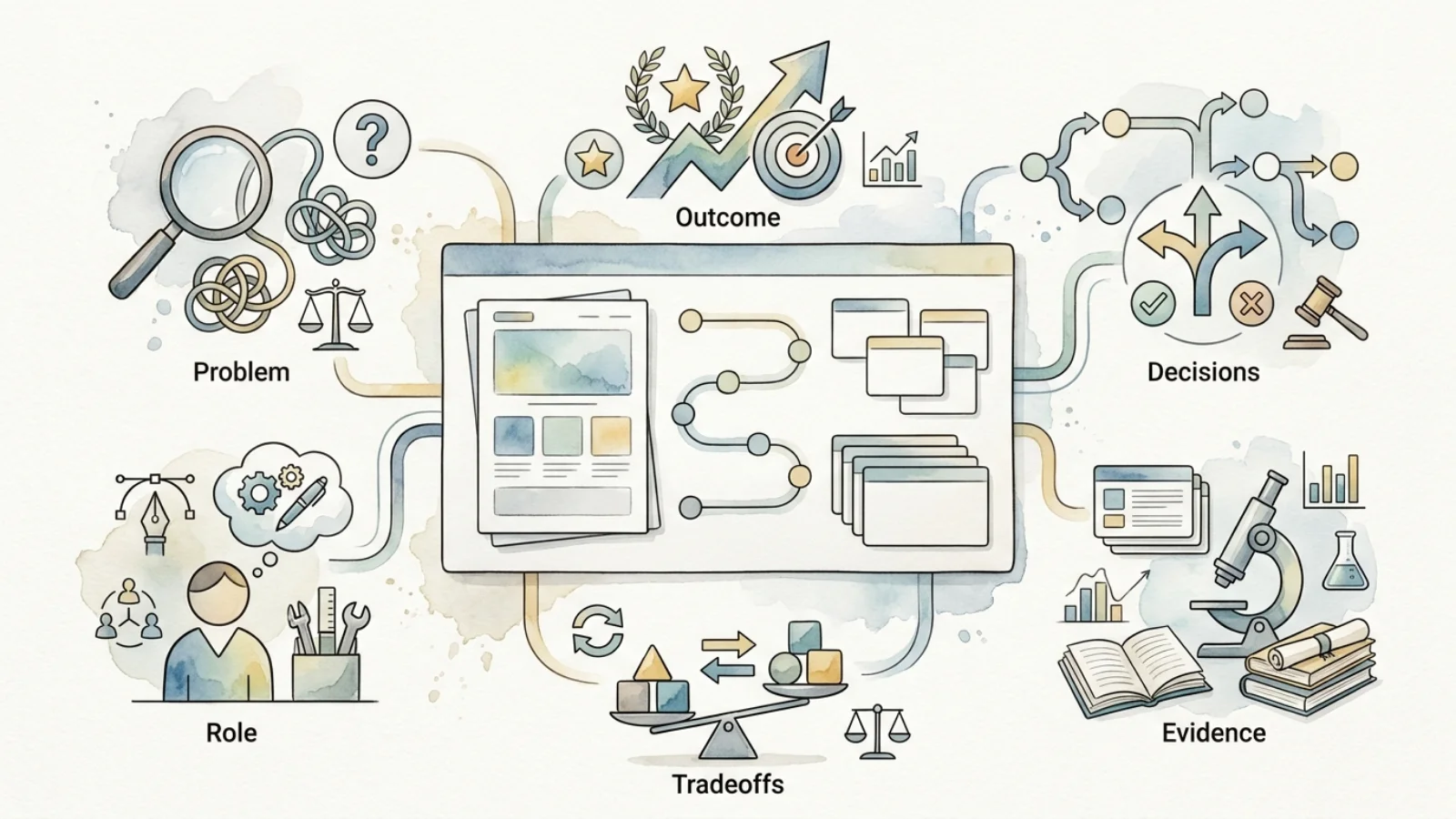
Publishing a case study is easy to treat as a formatting task. The harder question is whether the reader can understand your contribution without you explaining it live. A readiness scorecard gives you a simple way to test that before you share the link.
1. Problem clarity
Score yourself from 1 to 5. Can a reader understand who had the problem, where it happened, and why it mattered? A low score usually means the case study begins with the solution or a broad statement about improving experience. Add context until the problem feels specific enough to evaluate.
2. Role and contribution clarity
Can the reader tell what you personally did? This matters in team projects. Name your responsibilities, your level of ownership, and the moments where your decisions shaped the work. Avoid making the entire project sound like an individual effort if it was collaborative.
3. Decision visibility
A case study should not only show steps. It should show decisions. Review each major section and ask what changed because of that activity. If a research section does not affect the design direction, either strengthen the connection or remove the section.
4. Evidence quality
Evidence can come from interviews, tests, analytics, stakeholder input, support tickets, or market constraints. The question is whether the evidence supports the decision you are making. Do not add numbers unless they are real. A qualitative observation can be enough when it is specific.
5. Trade-off articulation
Strong case studies show that design choices have costs. Did you choose speed over depth, simplicity over control, or a narrow scope over a broader feature set? Name at least one tension that shaped the final direction.
6. Impact and learning
Impact does not always mean a business metric. Especially for junior work, it may mean what improved in testing, what became clearer, or what you would measure next. The section should help the reader understand what the project changed or taught you.
Frequently Asked Questions
How should I score my case study? Use 1 to 5 for each area and focus first on the lowest score. Do not try to fix everything at once.
What score means the case study is ready? There is no universal number, but weak scores in problem clarity or role clarity usually need attention before publishing.
Can I use this scorecard for a bootcamp project? Yes. It is especially useful when professional context is limited.
Should impact always include metrics? No. Real metrics are useful, but invented metrics damage trust. Use qualitative impact when that is what you have.
What is the most important scorecard item? Role clarity and decision visibility are often the two biggest signals in a hiring review.
This article was created in collaboration with AI · Editor: Ömer Arı
Related reading
Jun 3, 2025
3min read
How Hiring Panels Actually Score Case Studies in 60 Seconds
Learn what hiring panels look for in the first 60 seconds of a UX case study review and how to make your decisions easier to read.
Feb 25, 2025
3min read
How to Write the Problem Statement in a UX Case Study
Learn how to write a UX case study problem statement that gives hiring managers clear context, scope, and decision criteria.
Jul 8, 2026
12min read
Anatomy of an interview-ready UX case study
The same UX case study written twice, section by section. See why the weak version fails a hiring manager's scan and what makes the strong one work.