Portfolio
Portfolio Types Explained: UX, UI, Graphic, Industrial and More
A clear guide to portfolio types for designers choosing what to emphasize when applying for different roles.

Ömer Arı
6 min read
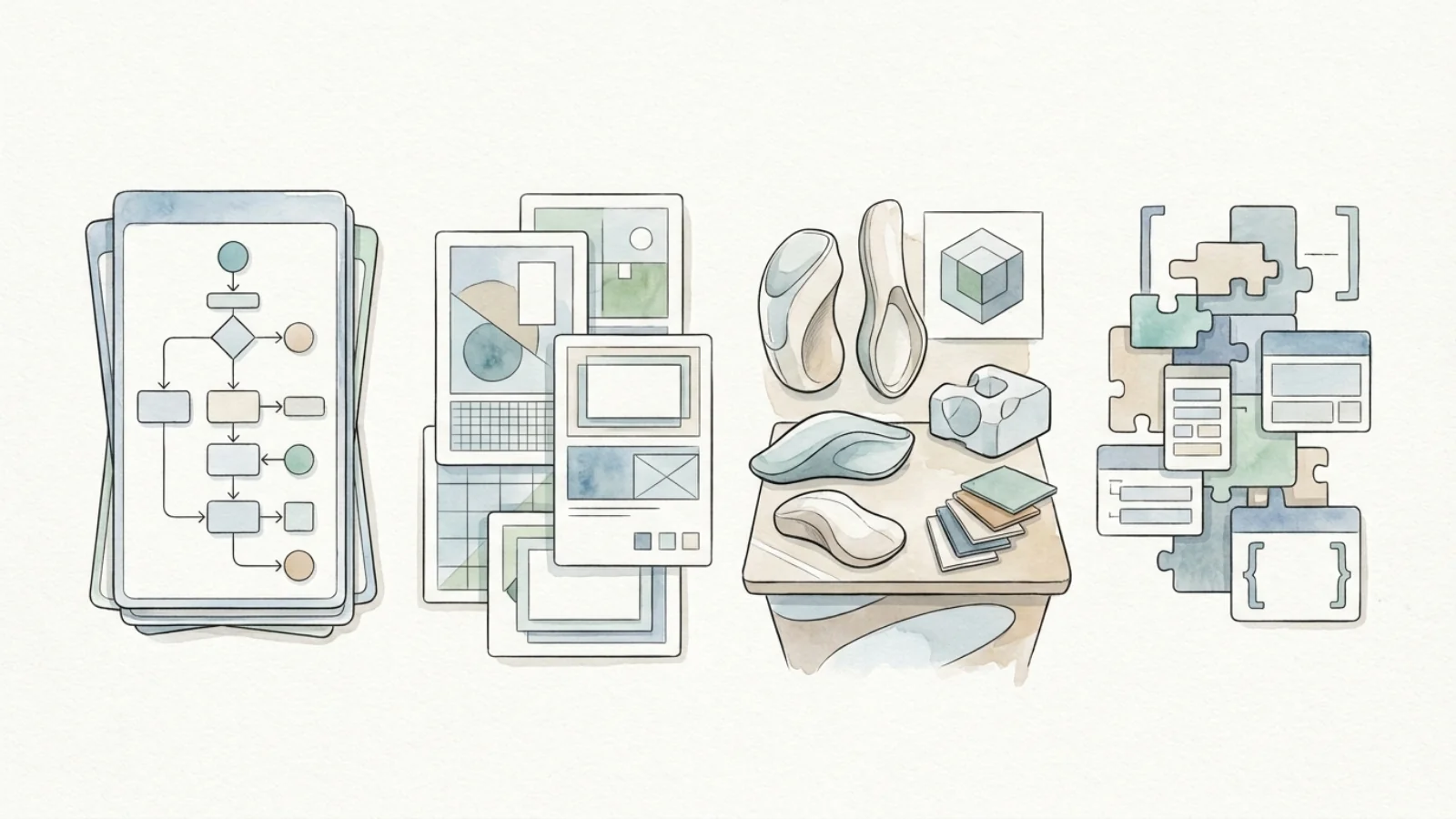
This article is for designers who are unsure whether their portfolio should be called UX, UI, Product Design, Graphic Design, Industrial Design, or something else. You will learn what each portfolio type should emphasize, how to match your portfolio to the roles you want, and how to avoid confusing reviewers with the wrong label.
The label should help the reader understand your work
Portfolio labels create pressure because they feel like identity decisions. A designer may ask, “Am I a UX designer, a UI designer, or a product designer?” That question can become abstract very quickly.
A better question is more practical: what type of role are you applying for, and what evidence does that role need to see?
A portfolio is not only a collection of work. It is a positioning tool. The label you use should help the reader understand what to look for. If your homepage says “UX Designer,” the case studies should show problem framing, user understanding, flows, decisions, and validation. If it says “UI Designer,” the work should show visual hierarchy, interaction states, layout systems, and craft.
Confusion happens when the label and evidence do not match. A portfolio may say product designer, then only show brand posters. Another may say UX designer, then show ten polished screens with no context. The work may be good, yet the reader does not know how to evaluate it for the role.
You do not need to pick one label forever. You need a portfolio version that matches your current job search.
Choose the type based on the job you want
Here is a practical way to separate the main portfolio types.
UX portfolio. A UX portfolio should focus on how you understand and improve an experience. It usually includes research input, problem definition, user journeys, flows, information architecture, prototypes, testing, and iteration. The final UI matters, although the main evidence is the reasoning behind the design.
UI portfolio. A UI portfolio should focus on the quality of interface execution. It should show layout, typography, color use, spacing, components, responsive behavior, states, and visual consistency. Strong UI portfolios still need context, since screens without a problem can look decorative.
Product design portfolio. Product design sits between UX, UI, product strategy, and business constraints. A product design portfolio should show problem framing, trade-offs, collaboration, shipped or realistic outcomes, and the ability to move from ambiguity to a usable solution. It should not read like a process template. It should show judgment.
Graphic design portfolio. A graphic design portfolio should emphasize visual communication. It can include brand identity, campaigns, editorial work, packaging, posters, social media systems, and motion pieces. The work should explain the message, audience, medium, and constraints.
Industrial design portfolio. An industrial design portfolio should show physical product thinking. Sketches, form exploration, ergonomics, materials, manufacturing constraints, prototypes, and product photography often matter. The reader wants to see how the object works in the real world, not only how it looks.
Service design portfolio. A service design portfolio should show connected touchpoints. It may include journey maps, service blueprints, stakeholder needs, operational constraints, and backstage processes. The strongest examples explain how the service changes across time, channels, and roles.
Motion or interaction portfolio. This type should show behavior over time. Microinteractions, transitions, motion principles, prototypes, and interaction logic matter more than static screenshots. Videos or short clips can help, as long as they are easy to scan.
The category you choose should match the jobs you are applying to. If the job titles are “Product Designer,” your homepage should not position you mainly as a graphic designer unless that is your deliberate angle. If the roles ask for UX research and interaction design, your portfolio should not rely only on Dribbble-style UI shots.
Build the portfolio around evidence, not labels
A useful exercise is to create a role evidence table. Write the role you want at the top, then list what that role needs to see.
For a UX role, evidence might include user problem, research method, flow improvement, testing insight, and iteration.
For a UI role, evidence might include visual system, component behavior, responsive layout, accessibility choices, and interaction states.
For a product design role, evidence might include business context, user need, product constraint, decision trade-off, cross-functional collaboration, and outcome.
Now compare your current projects against that evidence. Do not ask whether the project looks impressive. Ask whether it proves the right thing.
A designer applying to product design roles may have a beautiful graphic identity project. It does not need to be deleted. It may need to move lower in the hierarchy, or it may need a different explanation. Instead of presenting it as a main case study, it can appear in an “additional visual work” section.
A designer applying to UI roles may include a UX case study, yet the case study should not bury the interface craft. Add sections on component decisions, layout rules, accessibility checks, and interaction states. The same project can support different positioning when the emphasis changes.
Specialization is also less dramatic than it sounds. You can specialize for the purpose of your portfolio without limiting your entire career. Your portfolio can say, “Product designer focused on complex flows and clear interface systems.” That is specific enough to guide the reader, while still leaving room for range.
The most risky choice is trying to sound like everything at once. “UX/UI/Product/Brand/Graphic Designer” can make the portfolio feel unfocused. If you have range, organize it. Put the main role first, then use supporting sections for adjacent skills.
For example:
“Product designer focused on UX flows and interface systems.”
Then your navigation can include:
Case studies Selected UI work Visual experiments About
This tells the reviewer what the main story is and where the supporting work belongs.
Rewrite your homepage around one role
Open three job posts you would actually apply to. Look at the responsibilities and portfolio expectations. Then rewrite your homepage label, project order, and case study descriptions around that role. Keep your range, yet make the first impression clear enough that the reader knows exactly how to evaluate your work.
This article was created in collaboration with AI · Editor: Ömer Arı
Related reading
Apr 22, 2026
7min read
UX vs UI: Why Final Screens Are Not Enough in a Portfolio
Learn the practical UX vs UI difference in portfolio writing, and how to make design reasoning visible beyond polished final screens.
Jan 15, 2026
5min read
The Junior Designer's Portfolio Guide: Starting From Zero
A practical guide for junior designers with no shipped projects who need to build a clear, honest UX portfolio.
Jan 5, 2026
6min read
UX Portfolio Examples: What They Do Right
An anonymized analysis of strong UX portfolio patterns, from homepage hierarchy to role clarity and case study selection.